
Raphael, Rent Freezes, and the Magic of Trees
On trees, motherhood, Raphael at the Met, Matisse at Acquavella, Manhattan and Brooklyn rental data, and why a blanket rent freeze hurts the city.

Contents
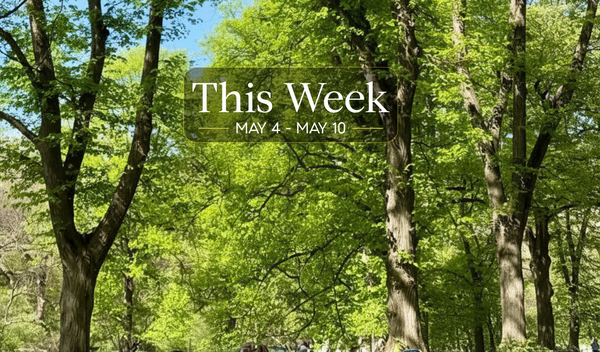
Early May in Central Park. Mature trees, young leaves, luminous green against a deep blue sky.
Happy Mother’s Day
This week, at a small dinner, someone asked a simple question: What has felt awe-inspiring to you recently?
There were many answers, personal and varied. But a pattern emerged.
Again and again, people came back to nature. To the quiet force of it.
And to trees, in particular.
How they form communities beneath the surface. How they communicate, protect their saplings, and give each other space to grow.
It stayed with me.
It made me think of Mother Nature, and of motherhood.
Happy Mother’s Day to all the extraordinary women who inspire awe in me every day.
This week: two exhibitions worth making time for, a rental market that’s off the charts in most price segments, the case against a blanket rent freeze, and new listings.
Raphael at the Metropolitan Museum: Worth the Crowds

Portrait of Baldassare Castiglione, c. 1514–15. On loan from the Louvre. Castiglione was Raphael’s close friend and one of the great Renaissance humanists. The painting is considered one of the finest portraits of the High Renaissance, and one of the most influential. Rembrandt copied it. So did Rubens.
Raphael: Sublime Poetry at the Met is the first comprehensive Raphael exhibition ever mounted in the United States — and it shows. More than 200 works pulled from the Louvre, the Vatican, the Uffizi, the Prado, and dozens of private collections, tracing his entire career from Urbino to Rome. Raphael lived from 1483 to 1520. He died at 37 and left behind more than 500 works. The math alone is staggering.
The Met describes his imagery as having “visual power, intellectual depth, and tenderness.” What struck me was the range, the mastery of his sketches, the psychological intensity of his portraits, the colors that still jump off the canvas five centuries later. He was working against the rigid traditions of the High Renaissance, simplifying and humanizing at a moment when most painters were doing the opposite. You feel the departure. The show’s title comes from an ancient dictum Raphael lived by:
“Painting is a mute poetry, and poetry is a blind painting.”
The exhibit runs through June 28. It’s a must-see.
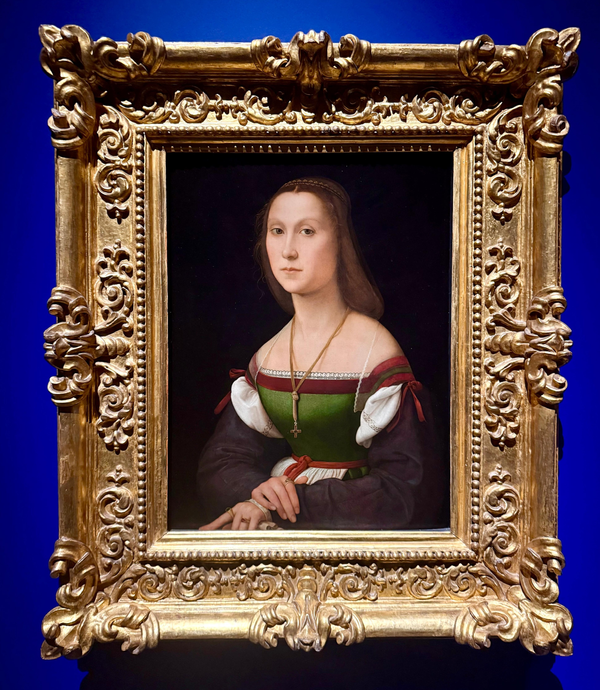
La Muta (The Silent One), c. 1507. On loan from the Galleria Nazionale delle Marche, Urbino. The sitter’s identity remains unknown and scholars have debated it for centuries. Her name comes from her expression: tight-lipped, unreadable, and arresting.
”Matisse: The Pursuit of Harmony” at Acquavella
This is at the top my list. It closes May 22, don’t let it slip.
![HENRI MATISSE: L'Idole [The Idol], 1906](/images/blog/raphael-rent-freezes-and-the-magic-of-trees/image-05.jpg)
HENRI MATISSE: L’Idole [The Idol], 1906
NYC Rental Market Update
Manhattan Market
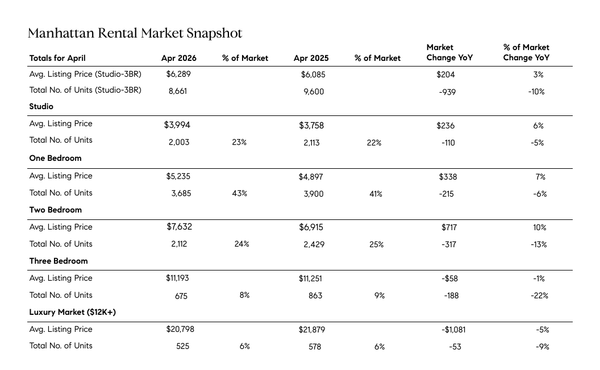
April rents are up year over year (YOY) in the broader market (studios to 2-bedrooms). 3-bedroom rents have held steady. Luxury rentals above $12K per month are down 5%. See the Table below.
Inventory in all price segments is down, ranging from 5% to 22%.
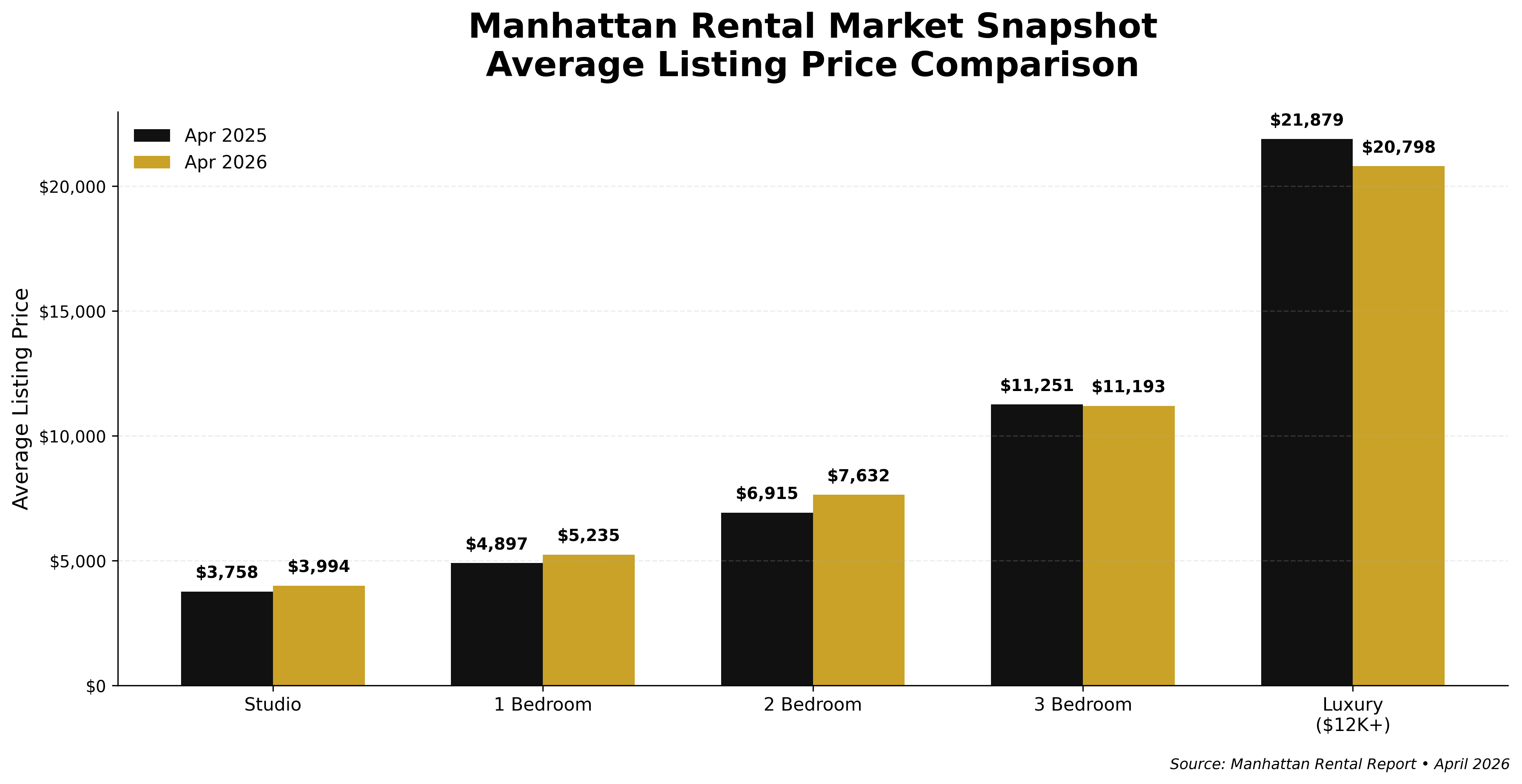
Monthly rents for Studios average $3,994 (up 6%), for one-bedrooms $5,235 (up 7%), two-bedrooms $7,632 (up 10%).
Rents for 3-bedrooms was largely the same with only a 1% drop. Average rent: almost $12K per month.
The exception: luxury rentals above $12K+, where average listing price dipped 5% to $20,798 and inventory contracted 9%.
The chart below tells the story visually: every segment is up except luxury, where pricing pulled back slightly from last year’s highs.
Brooklyn Market
Brooklyn is running hotter on inventory than Manhattan. Total units are up 14% YOY, with one-bedrooms up 19% and two-bedrooms up 24%.
Prices are rising like Manhattan, but more modestly.
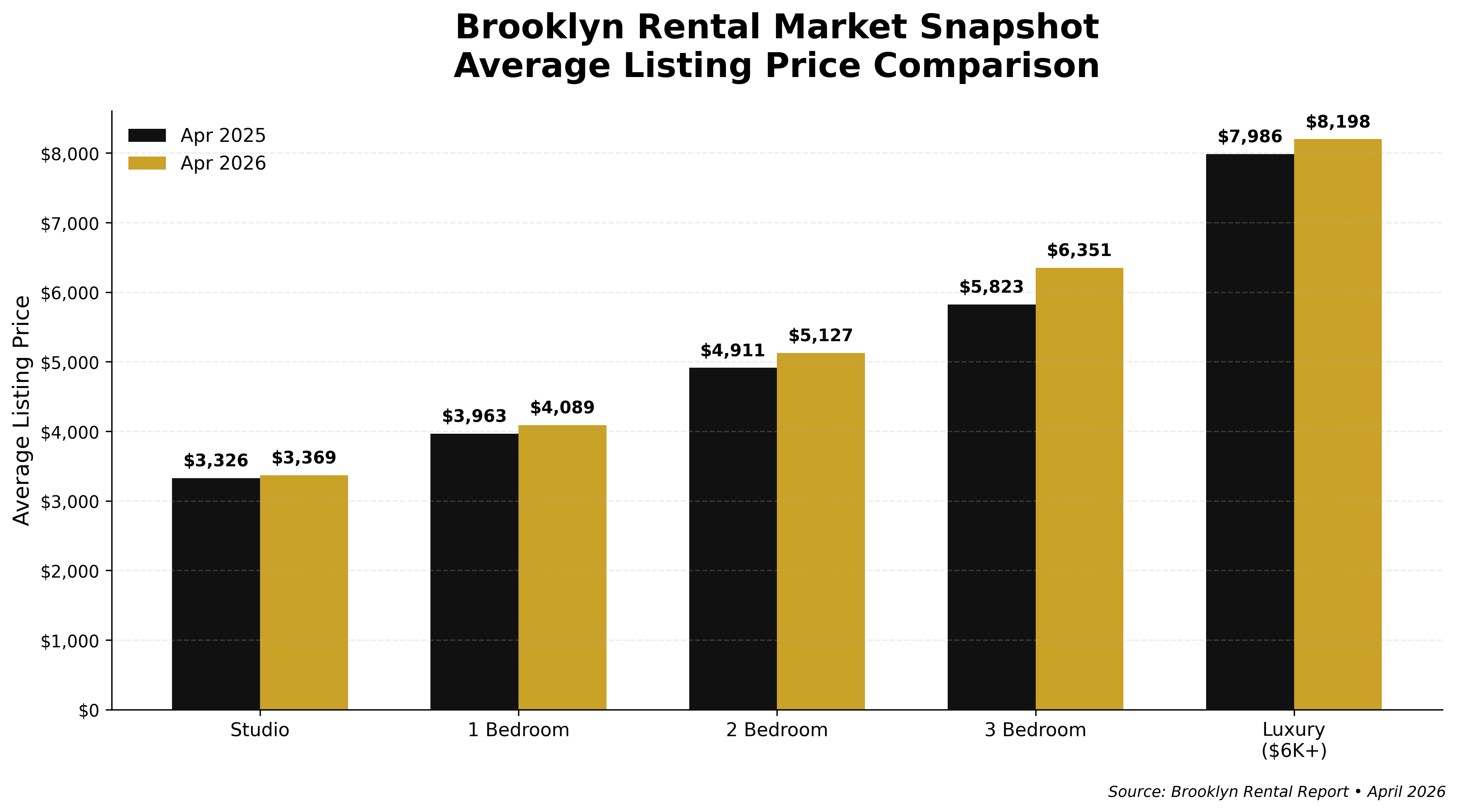
Studios up 1%, one-bedrooms up 3%, two-bedrooms up 4%.
Three-bedrooms are the outlier: up 9% in price while inventory dropped 20%.
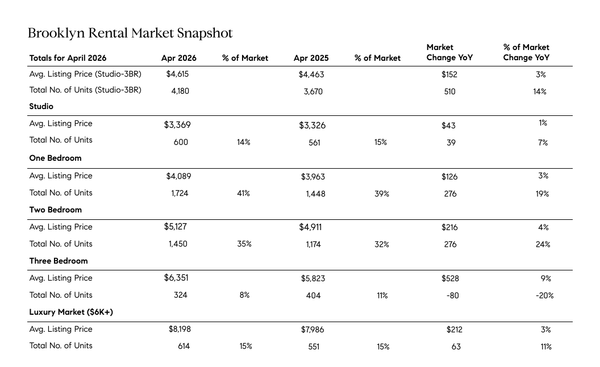
Across every bedroom count, Brooklyn rents are higher than a year ago, with three-bedrooms and luxury ($6K+) showing the most pronounced jumps.
Rent Freeze: Good for Optics, Bad for The City
The Final Vote is June 25
A rent freeze is now within reach. Last Thursday, the Rent Guidelines Board voted a preliminary range of 0% to 2% for 1-year leases on roughly 1 million stabilized apartments. The final vote is June 25.
This is not a new story. Rent freezes have been enacted before, and yet here we are, with Manhattan rents among the highest in the country. The policy has never solved the underlying problem.
What it does do is transfer the cost. Landlords are not exempt from rising property taxes, insurance premiums, labor, energy, and maintenance costs — none of which get frozen. Owner operating costs rose 5.3% this year alone, including an 11% jump in fuel and 10.5% in insurance.
To be fair, the data is not uniform. Larger mixed portfolios are doing reasonably well. Smaller, fully stabilized pre-1974 buildings are not. A blanket freeze treats them the same, which is neither accurate nor fair.
But the deeper problem is that none of this addresses supply. More housing means more competition means lower rents.
It really is that simple. There is actually a supply-side incentive already on the books: 485-x, known as the Affordable Neighborhoods for New Yorkers program, offers developers up to 40 years of property tax exemption on new residential construction — in exchange for setting aside at least 25% of units as permanently affordable. It went into effect in December 2024 and offers its most generous terms to developers who break ground before June 30, 2026.
Instead of freezing what landlords can charge, the city should be doing everything it can to make sure programs like this actually work by removing the regulatory and tax obstacles that make building so costly in the first place. Provide a reason to invest in the city, and the market does the rest.
Rent freezes make for good press releases.
Supply solves the problem.